|
|
| Line 34: |
Line 34: |
|
| |
|
| === Controls === | | === Controls === |
| The Williams Defender cabinet shared the "base cabinet" with many other games like Joust and Sinistar. This fact makes it very easy to make multiple control decks. The control decks dimensions are 23 1/2 inches by 8 inches made of 3/4 plywood. | | The Williams Defender cabinet shared the "base cabinet" with many other games like Joust and Sinistar. This fact makes it very easy to make multiple control decks. The control decks dimensions are 23 1/2 inches by 8 inches made of 3/4 particle board. |
|
| |
|
| We have a few leftover parts from the last MAME project, also a set ordered [http://www.ebay.com/itm/360450175737] form Ebay seller TwistedQuarter for $29.99 plus $10 shipping as a donation. | | We have a few leftover parts from the last MAME project, also a set ordered [http://www.ebay.com/itm/360450175737] form Ebay seller TwistedQuarter for $29.99 plus $10 shipping as a donation. |
|
| |
|
| <strike>Danny is currently running a custom firmware on an Arduino Uno and checking the results of that.</strike> '''Interface was too laggy'''
| | Danny is currently running a custom firmware on an Arduino Uno and checking the results of that. |
| | |
| == Custom Electronics for the Controls ==
| |
| A custom board was fabricated for controlling the buttons and joysticks [http://vusb.wikidot.com/project:mamepanel V-USB MAMEPanel] was ported to work for the Atmel atmega644p micro controller. The hardware currently emulates 2 joysticks with 8 buttons each and a keyboard hid device. MAMEPanel is expandable to 3 joysticks and a mouse input is also possible. Below is the current keymap:
| |
| | |
| <nowiki>
| |
| // Atmega32 Shift switch off
| |
| PROGMEM const unsigned char NormalMapping[NUMBER_OF_INPUTS] =
| |
| { // Pin Atmega Board Function
| |
| KEY_5, // 40 PA0 X6-1 COINTRIGGER
| |
| 0, // 39 PA1 X4-8 none
| |
| 0, // 38 PA2 X4-7 none
| |
| KEY_2, // 37 PA3 X4-6 JOY2START
| |
| KEY_1, // 36 PA4 X4-5 JOY1START
| |
| J1_Button8, // 35 PA5 X4-4 JOY1BUTTON8
| |
| J1_Button7, // 34 PA6 X4-3 JOY1BUTTON7
| |
| J1_Button6, // 33 PA7 X4-2 JOY1BUTTON6
| |
| 0, // 1 PB0 X9-2 SHIFTSWITCH
| |
| J2_Button8, // 2 PB1 X7-1 JOY2BUTTON8
| |
| J2_Button7, // 3 PB2 X7-2 JOY2BUTTON7
| |
| J2_Button6, // 4 PB3 X8-1 JOY2BUTTON6
| |
| J2_Button5, // 5 PB4 X8-2 JOY2BUTTON5
| |
| J2_Button4, // 6 PB5 X5-1 JOY2BUTTON4
| |
| J2_Button3, // 7 PB6 X5-2 JOY2BUTTON3
| |
| J2_Button2, // 8 PB7 X5-3 JOY2BUTTON2
| |
| J1_Up, // 22 PC0 X3-2 JOY1UP
| |
| J1_Left, // 23 PC1 X3-3 JOY1LEFT
| |
| J1_Right, // 24 PC2 X3-4 JOY1RIGHT
| |
| J1_Button1, // 25 PC3 X3-5 JOY1BUTTON1
| |
| J1_Button2, // 26 PC4 X3-6 JOY1BUTTON2
| |
| J1_Button3, // 27 PC5 X3-7 JOY1BUTTON3
| |
| J1_Button4, // 28 PC6 X3-8 JOY1BUTTON4
| |
| J1_Button5, // 29 PC7 X4-1 JOY1BUTTON5
| |
| J2_Button1, // 15 PD1 X5-4 JOY2BUTTON1
| |
| J2_Right, // 17 PD3 X5-5 JOY2RIGHT
| |
| J2_Left, // 18 PD4 X5-6 JOY2LEFT
| |
| J2_Up, // 19 PD5 X5-7 JOY2UP
| |
| J2_Down, // 20 PD6 X5-8 JOY2DOWN
| |
| J1_Down // 21 PD7 X3-1 JOY1DOWN
| |
| };
| |
| | |
| // Atmega32 Shift switch on
| |
| PROGMEM const unsigned char ShiftMapping[NUMBER_OF_INPUTS]=
| |
| { // Pin Atmega Board Function
| |
| KEY_5, // 40 PA0 X6-1 COINTRIGGER
| |
| 0, // 39 PA1 X4-8 none
| |
| 0, // 38 PA2 X4-7 none
| |
| AC_Mute, // 37 PA3 X4-6 JOY2START
| |
| KEY_P, // 36 PA4 X4-5 JOY1START
| |
| 0, // 35 PA5 X4-4 JOY1BUTTON8
| |
| 0, // 34 PA6 X4-3 JOY1BUTTON7
| |
| 0, // 33 PA7 X4-2 JOY1BUTTON6
| |
| 0, // 1 PB0 X9-2 SHIFTSWITCH
| |
| 0, // 2 PB1 X7-1 JOY2BUTTON8
| |
| 0, // 3 PB2 X7-2 JOY2BUTTON7
| |
| 0, // 4 PB3 X8-1 JOY2BUTTON6
| |
| 0, // 5 PB4 X8-2 JOY2BUTTON5
| |
| 0, // 6 PB5 X5-1 JOY2BUTTON4
| |
| KM_ALT_F4, // 7 PB6 X5-2 JOY2BUTTON3
| |
| KM_SHIFT_F7, // 8 PB7 X5-3 JOY2BUTTON2
| |
| KEY_UpArrow, // 22 PC0 X3-2 JOY1UP
| |
| KEY_LeftArrow, // 23 PC1 X3-3 JOY1LEFT
| |
| KEY_RightArrow, // 24 PC2 X3-4 JOY1RIGHT
| |
| KEY_Enter, // 25 PC3 X3-5 JOY1BUTTON1
| |
| KEY_Esc, // 26 PC4 X3-6 JOY1BUTTON2
| |
| KEY_Tab, // 27 PC5 X3-7 JOY1BUTTON3
| |
| 0, // 28 PC6 X3-8 JOY1BUTTON4
| |
| 0, // 29 PC7 X4-1 JOY1BUTTON5
| |
| KEY_F7, // 15 PD1 X5-4 JOY2BUTTON1
| |
| AC_VolumeUp, // 17 PD3 X5-5 JOY2RIGHT
| |
| AC_VolumeDown, // 18 PD4 X5-6 JOY2LEFT
| |
| KEY_PageUp, // 19 PD5 X5-7 JOY2UP
| |
| KEY_PageDown, // 20 PD6 X5-8 JOY2DOWN
| |
| KEY_DownArrow // 21 PD7 X3-1 JOY1DOWN
| |
| };
| |
| | |
| </nowiki>
| |
|
| |
|
| == Bill of Materials == | | == Bill of Materials == |
| *DC7600 | | *DC7600 |
| *Samsung 19 inch 930b LCD | | *Samsung 19 inch 930b LCD |
| *Arduino Uno
| |
| *Defender Arcade Cabinet | | *Defender Arcade Cabinet |
|
| |
|
MAME, an acronym that stands for Multiple Arcade Machine Emulator, is an emulator designed to reproduce older arcade system hardware via software on a modern personal computer.
MMMAME
(Midsouth Makers MAME Cabinet)
|
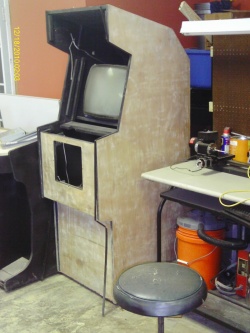
Sanded cabinet and gutted
|
| Information
|
| Owner
|
Group
|
| Lead
|
critter42 & MemphisArtGuy
|
| Version
|
2.0
|
| Status
|
In Progress
|
| Started On
|
November 2012
|
| Cost
|
Free
|
Design
Computer
- HP Compaq DC7600 Convertible Minitower PC 3.2 GHZ
- OS Ubuntu 12.04
- 2 HDD on SATA BUS - Roms Drive - OS Drive
- WIFI Adapter : ENUWI-G2 802.11 B/G
- 1Gb DDR2 - Would like to upgrade to 4Gb
- 19inch 3:4 LCD
Display
Audio
Software
Controls
The Williams Defender cabinet shared the "base cabinet" with many other games like Joust and Sinistar. This fact makes it very easy to make multiple control decks. The control decks dimensions are 23 1/2 inches by 8 inches made of 3/4 particle board.
We have a few leftover parts from the last MAME project, also a set ordered [1] form Ebay seller TwistedQuarter for $29.99 plus $10 shipping as a donation.
Danny is currently running a custom firmware on an Arduino Uno and checking the results of that.
Bill of Materials
- DC7600
- Samsung 19 inch 930b LCD
- Defender Arcade Cabinet
Contributors
External Links
Cabrio
Virtual HID Keyboard
Arduino USB Sheild
Teensy HID Keyboard
Arduino Uno HID Keyboard
References